As the family genealogist, there is nothing quite as thrilling as uncovering the tangible artifacts that trace the footsteps of our ancestors. During our recent Genetti family reunion in Wilkes-Barre this past October, two remarkable documents surfaced that have shed profound new light on our history. Together, they resolve long-standing timeline mysteries and paint a vivid picture of Damiano Genetti’s extraordinary life.
The Austro-Hungarian Military Certificate
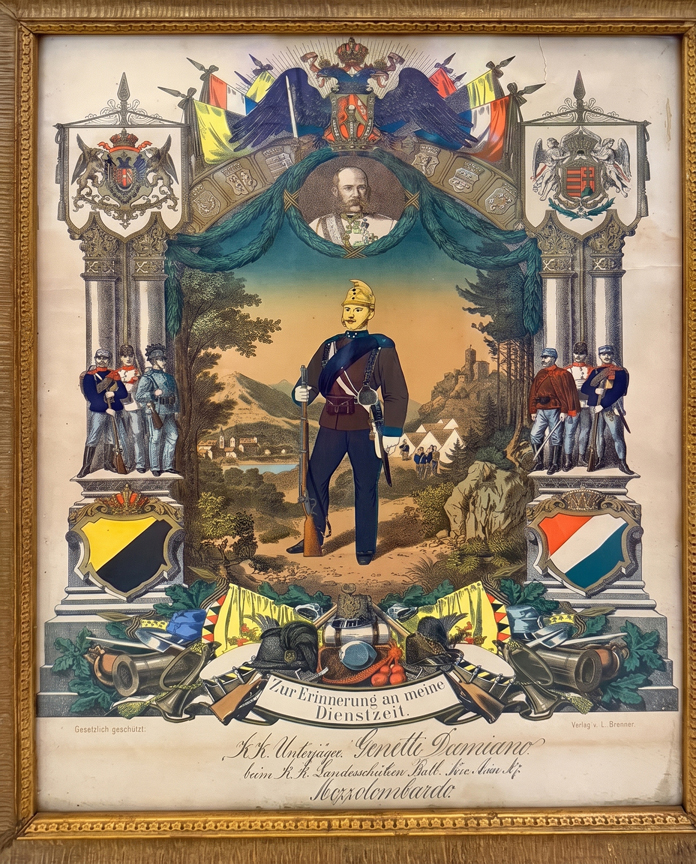
This beautifully preserved Austro-Hungarian military certificate—traditionally known as a Reservistenbild (remembrance sheet)—offers a fascinating window into a dramatic and pivotal chapter of Damiano Genetti’s life. The German calligraphy bordering the bottom, reading “Zur Erinnerung an meine Dienstzeit” (In memory of my time in service), commemorates his time serving Emperor Franz Joseph I as a K.K. Unterjäger (Imperial-Royal Corporal) with the Landesschützen, the Tyrolean territorial defense troops garrisoned in Mezzolombardo.
While such documents were standard rites of passage for young men finishing their mandatory conscription, Damiano’s path to earning his was anything but conventional. Having initially left the Trentino region in 1877 to evade the draft, family history notes that he was arrested upon his return in 1888 with his wife and infant son. Rather than a standard conscription memento, this certificate serves as the official proof of how he ultimately settled his deferred debt to the empire.
His assignment to a regional garrison in Mezzolombardo, located at the entrance to the Val di Non rather than a distant imperial outpost, proved to be a highly fortunate turn of events. During peacetime, territorial troops were frequently granted travel passes for overnight or weekend leave. Furthermore, Damiano did not merely serve out a punishment; earning the rank of Unterjäger indicates that he performed his duties exceptionally well and was integrated into the regular forces as a non-commissioned officer. This elevated status would have afforded him greater privileges and freedom of movement than a standard private.
Because his garrison was located just twenty-five miles from Castelfondo, Damiano was able to utilize this flexibility to travel home regularly. This proximity and his rank perfectly explain the seemingly contradictory timeline of his family’s growth, revealing how he was able to maintain his marriage and be present for his wife’s successive pregnancies in 1888, 1889, and 1890, all while completing his active military duty. Ultimately, this artwork stands as a testament to Damiano’s resilience—marking the successful resolution of his youthful draft evasion and his ability to honorably fulfill his obligations without sacrificing his growing family.
Our thanks to Patrick Genetti who provided this valuable piece of family history during our Reunion 2026 gathering.
Damiano’s 1903 Austrian Passport
The second document to surface is a true genealogical treasure, and before diving into its details, I want to extend my deepest gratitude to Anne Marie Shelby. Thanks to her incredible generosity in donating this passport to our family archive, this piece of our heritage will be preserved and studied for generations to come.
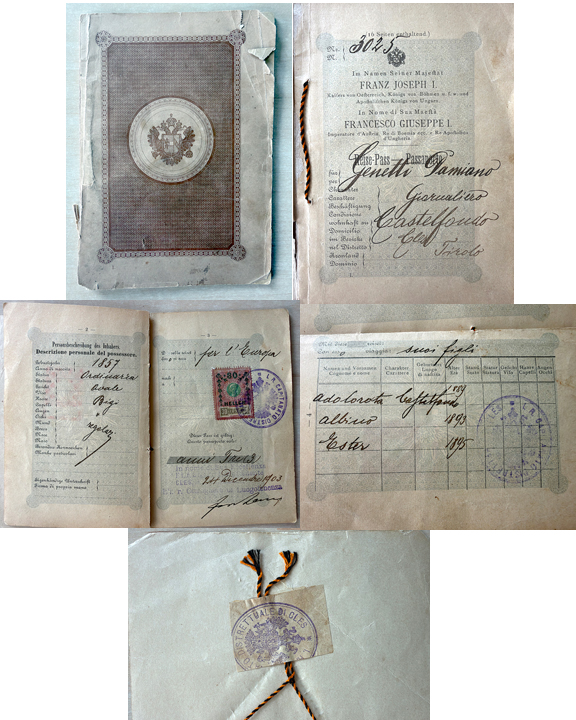
Issued in the Tyrolean district of Cles on Christmas Eve of 1903, Damiano Genetti’s bilingual Austro-Hungarian passport (No. 3025) provides a detailed snapshot of his life and family at the turn of the twentieth century. The document identifies Damiano as a resident of Castelfondo born in 1857, making his living as a day laborer (giornaliero). At forty-six years old, his physical description notes an average build, an oval face, regular features, and graying hair.
Crucially for the family record, the passport documents that Damiano was accompanied by three of his children, all born in Castelfondo. The interior log lists fourteen-year-old Adolorata (born 1889), ten-year-old Albino (born 1893), and eight-year-old Ester (born 1895) as his traveling companions.
Officially stamped by the Imperial and Royal District Captaincy of Cles under the authority of Emperor Franz Joseph I, the document explicitly granted the family permission to travel within Europe (per l’Europa) for a period of three years. However, Damiano ultimately used this document to emigrate to Pennsylvania. While this seems to contradict the passport’s continental limits, it was a standard procedural workaround of the era.
Austro-Hungarian citizens frequently obtained passports for European travel simply to legally cross regional borders and reach major embarkation ports. Requesting permission for local European travel was a faster, cheaper, and less heavily scrutinized administrative process than officially declaring permanent overseas emigration to the imperial authorities.
Once Damiano and his children reached their port of departure, the passport’s geographic restrictions no longer mattered. Steamship companies and United States immigration officials were primarily concerned with paid tickets, ship passenger manifests, and health inspections rather than the specific destination stamped on an origin passport. While technically only authorizing travel within Europe, this document successfully served its true, practical purpose: carrying the family out of the Austro-Hungarian Empire and onto the ship that would take them to their new life in Pennsylvania.
These documents are more than just pieces of antique paper—they are physical proof of Damiano’s determination, his resilience, and his absolute dedication to building a better future for the Genetti family.
Both documents can be viewed on the Pennsylvania Genetti Family Photo Gallery Page.

