I'm a photographer and digital artist. My passions are reading, traveling, art, hiking and genealogy. Between excursions to explore other countries and cultures, I spend most of my time building my family genealogy blog and creating digital art.
Since the intention of this blog is to discuss genealogy, family history and Tyrolean culture, I usually keep my posts on theme and don’t relate anything of a personal nature. However the past two months have brought a number of unusual circumstances into my life and I want to share these with you. So sit back with a cup of coffee while I relate the trials and tribulations of my recent adventures during self-isolation.
In September my computer crashed and burned! Yep, I had a dead laptop and a big headache to go with it! Since I rely heavily on my computer for just about everything (including this website and blog!) I knew I had to meet the problem head-on and get through it.
After a few days of online research using a borrowed laptop from my husband, I decided on a new PC, ordered it from Amazon and a week later my shiny new computer was delivered to my door.
Then the fun began! Luckily all of my graphic and genealogy files were saved to external hard drives. No problem there – all of my precious specialized files were safe and sound. And I had automatic cloud backup for my main hard drive through Backblaze. However I soon found out – reloading all of my software and then restoring thousands of files from my old computer to my new laptop was a massive job! Thank goodness I had cloud backup or I would have been in real trouble. The annual fee to Backblaze was certainly money well spent!
Since I am also a graphic artist, there are hundreds of embedded files such as fonts, etc. that had to be located and reloaded into the correct program. It took almost three weeks to get my new computer in working order. Although I lost a few apps and files here and there, for the most part I was back to normal by the beginning of October. This is one reason why you have seen so few blog posts from me in the past two months.
The second thing to occur in my life during this time of isolation is an unexpected turn on the genealogy research path. Since March I have been actively helping NPEs (non-parental events, adoptees) along with others who have family members with questionable parentage, locate birth parents and solve family mysteries. This has taken up the majority of my time and I now consider myself a full-time “Search Angel” (someone who works pro bono in helping others locate family). Within the past seven months, I have solved six “cases”, found a number of unknown half-siblings, yanked a few skeletons out of dark family closets and thoroughly enjoyed myself!
Helping others in their life-long search for the truth is both thrilling and rewarding. I now consider this to be my life purpose. So – I am currently in the process of channeling my genealogy energy towards the goal of being a full-time “gen geni” (genetic genealogist). Although I’m not exactly sure how this pivot will occur, I am making tentative plans to proceed in this direction. I love being a modern-day detective, using DNA and genealogy to solve family mysteries. And believe me – I have found many strange and unknown events hiding in every family tree that I have researched!
In closing, I would say there is certainly a silver lining to this time of self-isolation. With no social engagements to contend with and quiet days allowing for deep research and concentration, I have found a rewarding direction that naturally utilizes my personal skills.
Thanks for listening to my private ramblings! If there are any folks out there with lingering questions about their family origins (unknown birth parents, mysterious grandparents or unexplained DNA matches) send me an email and I’ll see if I can be of assistance.
We are sadden to hear that John A. Genetti of South Bend, Indiana passed away on October 6, 2020. John was the son of John Genetti and LaVerne Gonder, the grandson of John B. Genetti and Julia Rolando, and the great-grandson of Vigilio Genetti and Domenica Maria Dolzadelli.
Originally from Castelfondo, John’s branch of the Genetti family settled in Collinsville, Illinois and the surrounding area near St. Louis during the late 1800’s. His great-grandfather, Vigilio, had numerous descendants, many of whom still live near Collinsville.
It’s time to research the individual lives of those who appear in our photograph. I am always intrigued by the stories that emerge when digging into the genealogical record. Even the most mundane life can be an interesting glimpse back in time, capturing a snapshot of our ancestors. One of my favorite research exercises is to gather all of the clues left behind by a person or family and compile them into a life story.
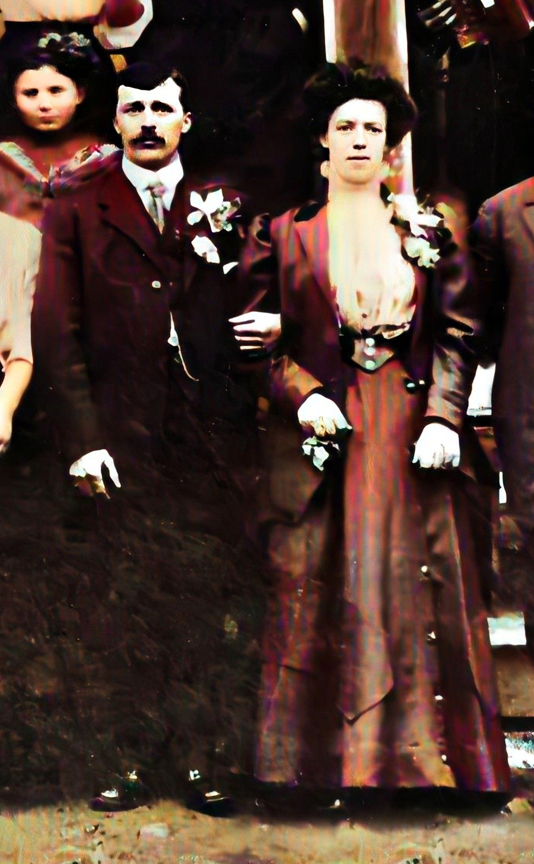
Let’s begin with one of our wedding couples from that momentous day: Richard Fedrizzi and Angeline Cologna.
“Richard” was baptized Riccardo Cesera Fedrizzi and this name appears on all of his official documents. However, he must have “Americanized” his name upon arrival in Pennsylvania and went by Richard in everyday life. I found several newspaper clippings for miscellaneous events and classifieds that all referred to Riccardo Fedrizzi as “Richard”.
He was born on December 15th, 1879 in Nanno, Austria (now Italy). Nanno is located in the Val di Non, not far from the city of Trento. Riccardo arrived in New York City on October 17, 1905 at the age of 26. He found work as a miner in the coal mines of Pennsylvania. His bride-to-be, Angeline Cologna, arrived soon afterward in December of 1906. Angeline was 22 years old at the time, having been born in Raina, part of the Commune of Castelfondo.
The young couple was married on Saturday, February 13th, 1909 in a double wedding with Riccardo’s sister, Virginia Fedrizzi and her groom Peter Dallachiesa. Most likely the ceremony took place at Sacred Heart Church in Weston, with the reception held at Raffaele Genetti’s saloon and boarding house located in the same village. The newlyweds setup housekeeping in Weston where they lived for most of their married life.
In December of that same year, Riccardo applied to become a naturalized citizen by filing his Declaration of Intention. It would take three more years before his Petition for Naturalization was filed and granted.
By February of 1910, the couple’s first child was born. Her name was Amelia. Two more children quickly followed in 1911 and 1912. As the years rolled by, their family continued to grow. Riccardo and Angeline became the proud parents of eight children. Sadly, little Amelia died in 1920 at the age of ten. Her death was attributed to tetanus. The rest of the Fedrizzi children all lived to adulthood.
Albert (1911-1998), Esther (1916-2001), Eugene (1919-2000) and Richard Jr. (1924-2000) moved to Niagara Falls, New York. Personally, I found the fact that four of the Fedrizzi children lived in upstate New York to be of interest as I grew up not far away in Buffalo, NY. Since I was a wedding photographer between the years of 1980 to 1991 and often worked in Niagara Falls, there was the opportunity that I may have encountered one of the Fedrizzi clan at a wedding. Who knows!
The other three children: Edith (1912-2000), Albino (1914-1964), and Victor (1925-living) all made their home in California. Eventually Riccardo and Angeline joined them on the west coast, spending their twilight years in the sunshine state. They moved in with their daughter Edith and her family.
Angeline passed away at the age of 74 on December 30, 1958. Riccardo followed a few years later, with his passing on September 30, 1963 at the age of 83. The couple is buried in Los Angeles County at Resurrection Cemetery.
Their one surviving child, Victor, is 95 years old and still resides in California. Being a first born American with both parents from the Val di Non, Victor is certainly one of the last living connections to our Tyrolean heritage.
In our next blog post we will look into the life of Riccardo’s sister Virginia Fedrizzi and her husband Peter Dellachiesa.
UPDATE: Thank you to Giovanni Marchetti for spotting an error in our text. Angeline Cologna Fedrizzi was born in Raina, which is part of the larger village of Castelfondo – not in Ravena as I had previously stated. According to San Nicolo baptismal records, Angeline was born on October 11, 1884 to Urbano Cologna and Rachele Ianes. Later documentation from the United States contained the error stating that Angeline was born in a different village. I have corrected my original blog post to read “Raina”.
Thank you Giovanni for helping with this correction! We are extremely grateful to all of our Italian cousins for reading our blog and sharing their knowledge with us! Mille grazie!
Raffaele Geneti (1867-1949) as a young man, photographed in Hazleton, PA. Raffaele is seated. The gentleman next to him is Pietro “Simone” Zambotti (1869-1939).
Remember our “rabbit hole”? Here is where my research took a new direction and like Alice in Wonderland, down I went into the ancestral void. Allow me to explain!
One of my favorite genealogy resources is Newspapers.com. Old newspapers can yield an amazing amount of information not found anywhere else. As I was scanning through local papers, searching for any clue to our missing children, I began seeing a pattern of references for Raffaele Genetti spanning about 35 years. Many of the clippings fell under the category of license submissions. Noting the dates, I realized they formed a chronological history of Raffaele’s business dealings.
I placed all of the clippings in order according to date beginning in 1895 and extending through 1923. Here’s what I found: Every February anyone involved in the food and liquor industry had to apply for a license to operate or continue operating a business. During the month of March, applications were reviewed and licenses granted at the end of that month. However, there seemed to be only a limited number of licenses available each year. Therefore a proprietor may be shut out of the process and not receive a license for the upcoming year.
The first year I found Raffaele referenced was 1895, applying for a liquor license in Black Creek Township, PA. It appears he was not granted a license for that year. In 1897 he applied again under a restaurant license in the village of “Hopeville”. The license was granted and we can assume that year was the beginning of his saloon business. But I wondered – where in the world was Hopeville? Although there are many little townships in the Hazleton area, I had never heard of this village. After a good bit of searching, I found an online history explaining that Weston was originally called Hopeville. Sometime after 1900 the village changed its name to its current moniker. One mystery solved!
So now we know Raffaele is attempting to establish a business in Weston around 1897. But it’s not until a few years later when he is finally granted a liquor license for his restaurant. We also see that in 1900 he has a license to operate a butcher shop in Union Township East, Schuylkill County. Raffaele’s sister, Angeline Genetti Recla, is the proprietor of a dry goods store in that township catering to miners in Schuylkill County. Since Raffaele and Lucia lived right next door to Angeline, we probably can assume he maintained a butcher business in collaboration with his sister’s store.
Considering these public records, this verifies Raffaele was attempting to build a new business in Weston while at the same time maintaining his original business in East Union before moving his family to his future boarding house establishment in Luzerne County.
From another article published in The Miners Journal dated July 1904, all did not go smoothly for Raffaele’s businesses. It reads:
WANTS $5,000 DAMAGES
Wilkesbarre, July 19 – An action for damage was yesterday commenced by Rafael Genetti, of Hazleton, against Anna R. Davis, of the same place. The plaintiff claims that owing to scandalous words uttered by the defendant about him he believes that his reputation has been damaged to the amount of $5,000 and he brings the suit to recover this amount.
The specific statement of which the plaintiff complains is to the effect that Genetti peddled meat that was not fit to eat and that he took some church money.
When I Googled the value of $5,000 from 1904 translated into today’s terms, I received the answer of a “relative inflated worth” of: $150,116. Obviously Raffaele was very serious about the claims made against him, so much so, that he brought a substantial lawsuit against the alleged defendant. And considering the woman’s claim that he had stolen money from the church, this was a direct personal attack against his reputation. If you remember from our previous posts, I mentioned a disagreement Raffaele had with the Weston priest. It’s a pretty good bet that this claim was the source of his anger! I could find no further reference in the papers for this lawsuit. We don’t know whether the court ruled in favor of Raffaele or the lawsuit was dropped.
The bad luck streak continued, with Raffaele’s liquor license denied during the years 1905, 1906 and 1907. Perhaps the lawsuit and alleged claims had something to do with the denial of his license. By 1908 things turned around and he once again regained his license to sell liquor at his Weston saloon. And in 1910 Raffaele was granted a license to operate a hotel and farm in Black Creek Township, Luzerne County, thus expanding his business holdings.
Of course, everything changed in 1920 with passage of the Prohibition Amendment. And sure enough, in an article dated February 1923, we find the following incident reported: “… agents had raided the saloons of Raffaele Genetti at Weston and Andrew Enama at Nuremberg where he secured a quantity of whisky and wine.” The article describes how local constables had turned a blind eye for several years to illegal liquor sales as well as gambling taking place at neighborhood businesses. Not trusting the local police to uphold prohibition laws, federal agents descended upon the area in 1923, raiding many businesses in Luzerne and Schuylkill counties.
Raffaele along with 23 other local “speak-easy” owners were arrested for “manufacturing, selling and possessing liquor, stills, spirits, coloring extracts and mash”. The paper continued: “The defendants arraigned were all held under $1,000 bail for court.” And: “The federal authorities will attempt to impose jail sentences upon the principals in every case.”
Considering how many businessmen were hauled into court at this time, Raffaele was certainly not the only saloon owner attempting to keep his business open by selling illicit booze. We even see a reference about illegal alcohol in Stanley Genetti’s biography, describing his brief dealings in the early 1920’s with a local bootlegging gang (see pages 21 – 22 of Stanley’s biography).
On April 3, 1923, Raffaele went before the court accused of “selling high voltage beverages.” Unfortunately we don’t know the outcome of the trial as I can find no follow-up reports in the 1923 newspapers nor can I find any court documents from that time.
But all was not lost! We know Raffaele bounced back from this set-back. From the memories of Raffaele’s granddaughter, Helene Smith Prehatny, we learn the former saloon/ dance hall was used from time to time for gatherings and events. Newspaper advertisements from the late 1920’s and early 1930’s announce public dances held at Raffaele’s establishment, proclaiming the “Big Tyrolean Dance at Genetti’s Hall Weston. Everyone welcome – good music!”
Raffaele concentrated his business efforts on farming and raising chickens, with help from his sons, who were by now grown men.
In 1933, the Prohibition amendment was repealed, allowing saloon owners to once again provide legal alcoholic libations to the public.
From the photos we have of Raffaele, I always thought him to be a dashingly handsome man. But now I also knew him as an interesting and colorful individual! You have to admit, the Genetti family was never boring!
Family of Raffaele (1867 – 1949) and Lucia (1865 – 1952) Genetti. Probably photographed in the mid-1940’s. Raffaele is standing in the middle, with Lucia seated. Their children from left to right: Mary Genetti Hudak (1901 – 1992), Elizabeth Genetti Smith (1904 – 1964), Silvio Genetti (1899 – 1982), Albert Genetti (1906 – 1990), Anna Genetti Nenstiel (1909 – 1974) and Leona Genetti Hayden (1903 – 1979).
We received an excellent comment from Conrad Reich suggesting I check parish records for baptismal and funeral information about little Alessandro and Raffaele Jr. I agree with Conrad, this appears to be the most logical place to search. Many of you are probably thinking the very same thing. I thought I should explain why this genealogical direction contains so many roadblocks.
If we look at public record, the family of Raffaele and Lucia Genetti were living in North Union, Schuylkill County, PA in 1900. Matter-of-fact, they were living right next door to Raffaele’s sister, Angela Genetti Recla. Soon after the 1900 Federal Census was recorded, the young family moved to Weston in Luzerne County, but we don’t know the exact date. Since both sons appear to have died right around this time, the question is what parish did the family belong to? Did they attend church in Schuylkill county or were they members of Sacred Heart Catholic Church in Luzerne County? Without exact birth and death dates, or knowing the family’s parish during these transition years, makes it extremely difficult to locate records.
The next hurdle concerning parish records is accessibility. You may not realize this, but the Catholic Church simply doesn’t share their records. Although you will find parish registries for some Catholic Churches in Europe through LDS catalogs at FamilySearch.org, the church has completely cracked down on allowing access to their records through any genealogy data base. If you search for Pennsylvania church records on Ancestry.com, you will find many registries for various Protestant faiths – but absolutely none for any Catholic Church in the state. This means the only possibility of gaining access to baptismal records would be to go directly to the church (remember, we don’t know the specific church the family attended at the time of the two boys’ passing) and inquire with the local priest. You may also find that the baptismal records you are seeking are no longer kept at the church but archived somewhere else. Plus Catholic priests are notorious for not responding to genealogy requests!
Since I live in New Mexico, making personal contact with the priest at Sacred Heart Catholic Church in Weston and tracking down the appropriate records is simply not feasible. Of course, if anyone else would like to undertake this task, I would be most appreciative!
Grave of Raffaele and Lucia Genetti, Calvary Cemetery, Drums, PA
Adding to this confusion is another issue. At our last family reunion I was told Raffaele had a discrepancy with the priest at Sacred Heart Catholic Church. As a result, Raffaele , Lucia and most of their family are not buried in Weston, but in Calvary Cemetery in Drums. Searching online cemetery records, it appears neither Alessandro nor Raffaele Jr. are buried near their family at Calvary. And I have yet to find an online grave listing for either of them in Weston or Schuylkill County.
FYI – this type of challenge is referred to in genealogy as a “brick wall” – and it can take years to break through!
However while I was conducting research about the family, I did stumble upon a series of notations published in the local newspaper containing enticing clues as to why Raffaele may have had a conflict with the priest in Weston. I’ll tell you all about it in our next blog post: Down the Rabbit Hole, Part 3!
Raffaele Genetti (1867-1949) and Lucia Zambotti Genetti (1867-1952) with their first child, Alessandro (1895-1900?). Photographed about 1897, Pennsylvania.
When you hang out with genealogists, a certain kind of lingo infiltrates your thinking. Such things as brick walls, NPEs and search angels are common jargon amongst my research friends.
Since my last blog post about the family of Raffaele and Lucia Genetti, one particular genealogy term describes my recent research: “falling down the rabbit hole”.
Allow me to explain. After publishing the last post in our series, Anatomy of a Photograph, I received several thoughtful comments addressing missing information. Two of the comments were from descendants of Raffaele and Lucia. I felt their concerns were valid and should be researched, with the possibility of updating our current tree.
Beginning my research as I usually do by accessing various online data bases, I soon found myself “falling down the rabbit hole”. In genealogy terminology this means: I lost my focus due to search results leading me in a totally unexpected direction. The information I stumbled upon was interesting enough to pursue further and was directly linked to the Weston saloon owned by Raffaele and Lucia.
Because of this, I am taking a short break from our original series and will present several posts addressing your previous comments, as well as present new research I have unearthed about the Genetti establishment.
Part 1
Two of the comments left on our blog were from the grandchildren of Raffaele and Lucia: Helene Prehatny and Ralph Genetti. Both thought there were eight children in the family, rather than the seven I mentioned in my original post. Although I had explained the death of the family’s oldest son, Alessandro, Ralph was sure there was another child named Raffaele Jr. who had died at birth. But Ralph had no specific information about the infant’s birth or death date or age at time of death.
This child was completely missing from our tree and I had no sources within my research indicating an eighth birth in the family. I agreed with Ralph that it required further investigation.
Since we had no specific information for Alessandro either, other than being mentioned in the 1900 Federal Census as being five years old, I felt it was necessary to do in-depth research for both boys.
Returning to my most reliable online sources, I scoured data bases for any mention of Alessandro or Raffaele Jr. I also searched Find-A-Grave and Newspapers.com for some scrap of evidence on either child. There was nothing. I even went back into my archive from San Nicolo in Castelfondo, hoping there may be a slim chance relatives of Raffaele or Lucia had notified the village priest of a family birth in Hazleton. (If the couple had relatives still living in Castelfondo and they had kept a close connection with family, sometimes you will find a birth in the United States included in the church’s baptismal records.) Unfortunately, once again I came up empty. There was simply no paper trail left for either infant.
As a genealogist, this places me in an unusual predicament. If I go by the rules, there is no confirmed evidence such as a grave or public record for an eighth child named Raffaele Jr. And since this child was born prior to the 1900 Federal Census, there is no one alive today with any memory of the birth. I know from experience, trusting stories as fact can often lead to inaccurate information entered into family trees and archives (our double wedding photo is a good example of this very thing!). Incorrect information is not useful for future generations of family researchers as it leads to generational mistakes.
It should also be noted that there is a common practice to exclude stillborn births and those that die in childhood from family trees as they produce no heirs to carry on the family line. Our original tree adheres to this philosophy as I have found dozens of births in the Castelfondo records where the child was dropped from various family branches due to death before reaching adulthood.
Since both Ralph and Helene were sure there was another child in Raffaele and Lucia’s family, I decided on a compromise. I have added little Raffaele to our tree but his birth and death dates are listed as “about 1897”. Since no one knows the facts about his birth date, age at time of death or death date, I had to use basic historical facts and make my best guess. We know from the 1900 Federal Census that Alessandro was born sometime around 1895 and the next child listed, Silvio, was born in 1899. There is a very good chance that Raffaele Jr. was born between these two children in 1897. Because he is not listed in the 1900 Census, we know that he did not reach the age of three and may very well have died as an infant.
In an attempt to keep our records as accurate as possible, the listings for both children have now been modified to read:
Alessandro Genetti, born about 1895, died between 1900 and 1910. Additional Note: There are no public records for the death of Alessandro. We know he appears in the 1900 Census as being 5 yrs. old, but he is not listed in the 1910 Census.
Raffaele Genetti Jr., born about 1897, died about 1897. Additional Note: There is no known evidence of the birth or death of Raffaele Jr. other than the memory of family descendants.
Watch for “Down the Rabbit Hole, Part 2” coming soon!
Time to look at the very person associated with our photo myth, Albert Lawrence Genetti. Albert is not pictured in our group wedding photograph. But for some unknown reason the date of his birth became part of the legend attached to this eventful day. Although we now know Albert was born in 1906, two and a half years prior to the date of the 1909 photo, public records show an interesting story also revolves around his birth.
Albert came into the world on October 21, 1906, the sixth child in a family of seven (note: Albert’s oldest sibling, Alessandro, passed away in 1910). According to Census records, his parents, Angelo Raffaele Genetti (Ralph) and Lucia Zambotti Genetti (Lucy), moved sometime around 1901 to Weston, Pennsylvania from North Union, Schuylkill County, where they had lived next door to Ralph’s older sister Angela Genetti Recla. The young couple established a large beer hall/boarding house in Weston, becoming prosperous entrepreneurs and growing their large family. Our double wedding was photographed on the front porch of Ralph and Lucy’s establishment.
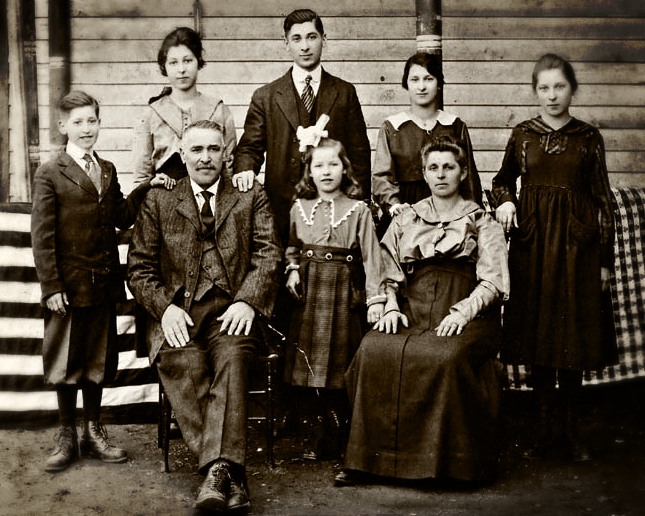
Raffaele and Lucia Genetti with their family, about 1914, probably photographed in Weston, PA. Front: Raffaele (1867-1949), Anna (1909-1974), Lucia (1865-1952). Standing: Albert (1906-1990), Leona (1903-1979), Silvio (1899-1982), Mary (1901-1992), Elizabeth (1904-1964).
To refute the original date of 1906 associated with our boarding house photo, I went in search of Albert’s birth certificate. This proved to be a difficult research task indeed. Due to numerous errors most likely made by the county clerk, not only was Albert’s surname misspelled as “Jenetti”, but his first name was also incorrect – plus the incorrect name was spelled wrong!
Albert Lawrence Genetti Certificate of Birth – Pennsylvania
Ralph and Lucy’s infant son is registered as: Rafile Jenetti. And if this wasn’t bad enough, the names of both of his parents were also misspelled as: Rafile Jenetti and Lucia Zambody. Never have I found a birth record with so many errors, making it extremely difficult to research!
Albert’s date of birth is also a conundrum. The day and time are recorded as October 22, 1906 – 7 p.m. However, all other public documents for Albert Genetti (Social Security Death Index, WW II Draft Registration, U.S. Public Record Index and the U.S. Find A Grave Index) state his birth as October 21, 1906. Was Albert’s certificate of birth also wrong about his date of birth? Or did he and his family decide to celebrate his birthday on the 21st rather than the 22nd? I guess we will never know the answer to this puzzling question, but I’m betting the county clerk was not the most competent person for this job!
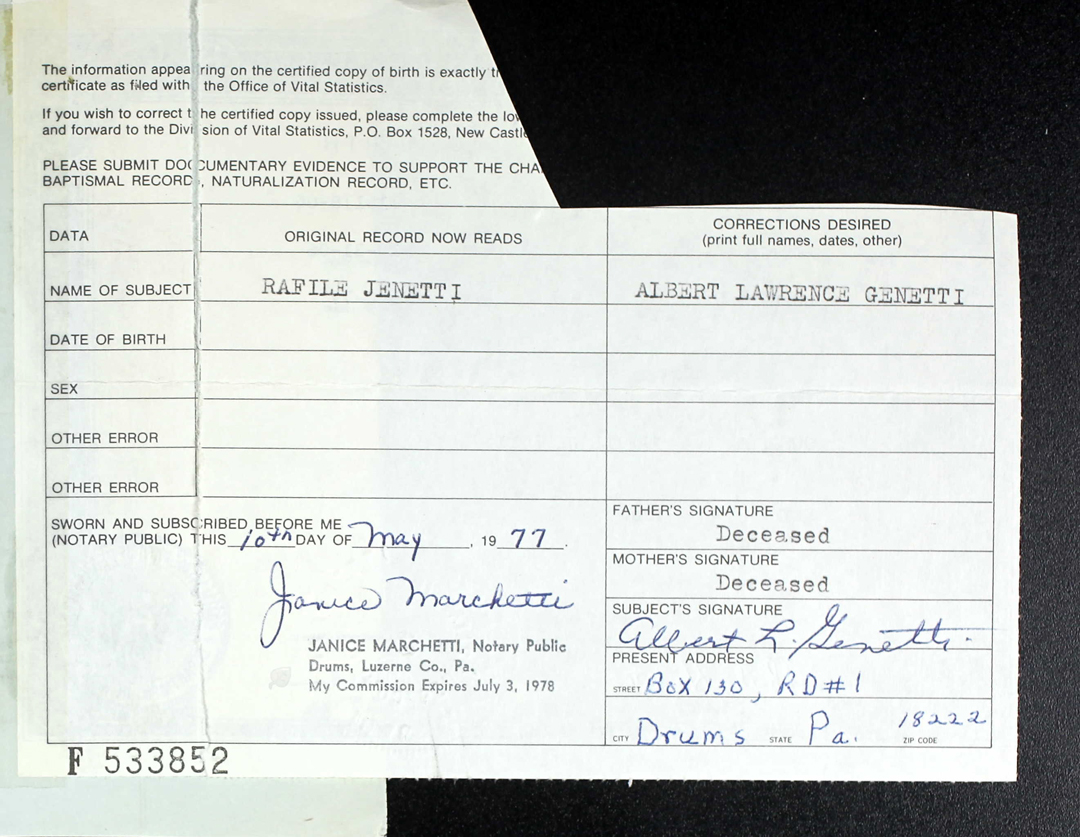
Amended birth record
In a backwards kind of way, I stumble upon the original birth record by first finding a revised correction of the document that had been notarized and filed on May 10, 1977. In that year Albert finally had the name on his birth certificate corrected to read Albert Lawrence Genetti. However his date of birth remained as October 22, 1906.
Albert and Vivian Genetti with sons Ralph and Lawrence.
Albert married Vivian Ellen Kummerer on January 20, 1940. They had two sons: Ralph and Lawrence. He had a long and successful career with Jeddo-Highland Coal Company, and became a well respected member of his community, belonging to numerous organizations. Albert passed away on December 15, 1990. You can read the obituary of Albert L. Genetti by clicking here.
Our thanks go to Ralph and Lawrence Genetti for sharing this fascinating photograph. It has added much to our family history!
In our next blog post, I will look into the lives of our two wedding couples from 1909.
Update: August 26, 2020
Thanks to comments from our readers, we have added an eighth child to this family: Raffaele Genetti Jr. (abt 1897? – abt 1897?).
Click here to read more about this additional child here.
Marriage License of Peter Dallachiesa and Virginia Fedrizzi
Time to search for the actual date of our double wedding! Fortunately, the state of Pennsylvania has cooperated with Ancestry.com in releasing many of their public records. Although not all documents are available at this time, Pennsylvania birth, marriage and death records are continually being updated with new information.
Now that I knew the identity of our wedding couples, I did a general search using the names of both grooms, leaving open the date of the wedding. Yes! Success! The marriage licenses issued for Peter Dallachiesa and Riccardo (labeled as Richard in the photo) Fedrizzi were easily accessible online!
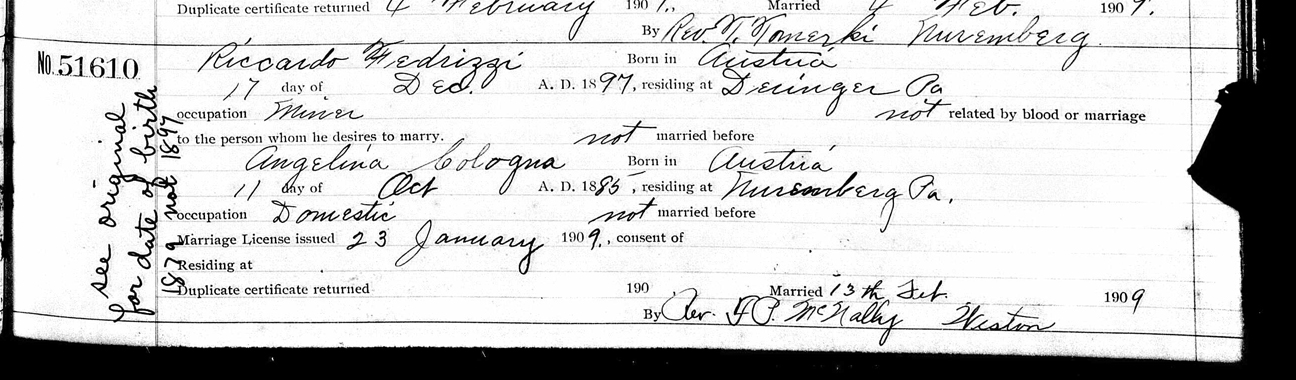
Marriage License of Riccardo Fedrizzi and Angelina Cologna
The licenses were both issued on January 23, 1909 with the marriage date set as February 13, 1909. Now we had the exact date of our group photo and confirmation through public record. This later date made much more sense as Tillie Genetti had now been in the United States for over two years and by this time was most likely participating in social gatherings with family and friends. I made the correction to our Photograph page with the double wedding officially taking place on February 13, 1909. According to Google, this date fell on a Saturday.
If we look a little closer at Riccardo and Angelina’s license record, we see an interesting mistake. Errors are common as I have often found name, spelling and date mistakes in many public records – especially in rural communities where correct spelling was not all that important. For this reason, it’s always a good idea to find several sources to confirm historical information.
In this case the birth date of Riccardo Fedrizzi is stated as December 17, 1897. Hmmmm – that would mean our groom was only twelve years old at the time of his wedding! Luckily, someone later spotted the error and made the correction using a side note next to the record. The year of his birth had been transposed and should have been 1879 – making Riccardo a respectable 29 year old groom. His bride, Angelina Cologna, was 23 years old.
Anna Ottilia Genetti Nensteil
With our mystery solved, I wondered how the story of Lucia giving birth became associated with this photo since Albert’s birth date did not match that of the wedding. Maybe one of Raffaele and Lucia Genetti’s other children had been born on that day. Since Albert was second to the youngest, the only possibility would be his little sister, Anna Ottilia.
Returning back to our Ancestry records, I soon located Anna’s birth record. It was dated January 9, 1909. Well that was close to our wedding date, but obviously a month prior to our nuptial event. Apparently somewhere along the line a creative family historian had attached a fanciful story to the photograph and the legend stuck.
On a final note, look closely at Anna’s birth record. There are two mistakes – her middle name is incorrectly spelled as is her father’s name! So much for accuracy! I guess that’s the job of a family genealogist – to find and correct the errors of by gone days.
Anna’s birth record
In our next blog post we will begin exploring individual stories connected to our wedding photograph.
Manifest of Alien Passenger for the U.S. Immigration Officer at Port of Arrival – 1906
Let’s skip ahead to 2020 and the discovery that inspired this entire series. During the past year I had been working with Loretta Cologna transcribing the school notebook of Tillie Genetti, who was my grandfather’s younger sister. As we worked through the text, adding historical information about Tillie and her siblings, I naturally used a timeline to trace personal information and immigration dates for my great-aunts and uncles. The family had arrived during three separate years: 1902, 1904 and 1906. Tillie, with her mother and five siblings, disembarked from their ship at Ellis Island in 1906. Although I had always been aware of the family’s immigration years, I had not paid close attention to the specific dates other than noting the Manifest Passenger List as a source citation in my Ancestry family tree.
Record of Aliens Held for Special Inquiry – arrival date December 3, 1906
While working on the school notebook, I was particularly interested in the transitional period of Tillie’s life between her final school year in Castelfondo and her new life in Pennsylvania. As I created her timeline I noted Tillie’s arrival in New York City on December 3rd, 1906. This date is correct and confirmed through public record according to the ship’s manifest and Ellis Island passenger records.
L to R: Dora Genetti, Richard Fedrizzi, Angeline Cologna, Tillie Genetti
A few months later while I was updating sections of our family website and playing with a new photo colorization tool, I stopped in my tracks! It suddenly occurred to me – the date included in the caption for the boarding house photo was suspect! Since Tillie and her older sister Dora had both attended the wedding and were clearly pictured standing in the front row, the date of October 1906 could not possibly be correct. Here’s why: while we believe Dora arrived sometime in 1902 with her father and sister Ester (there are no public records to confirm this year), Tillie had not arrived until much later in December of 1906 – three months after the supposed date of when the photo was taken – October of 1906!
Obviously, the story of Lucia Genetti giving birth upstairs in 1906 while a wedding took place downstairs was an interesting family legend – but alas, not founded in truth! Public immigration records verified this date could not be accurate as Tillie was not living in Pennsylvania in October 1906!
But what was the true date?
Although I was fond of the story attached to our infamous photo, it was obvious that we needed to correct the misnomer. It was time to dig into Pennsylvania marriage records at Ancestry.com to learn more!
Part 4 – coming soon!
Note – In both documents from Ellis Island we see that Oliva and her five children were detained for further examination. It appears that little Ann was only about three years old at the time and suffering from a hip problem. In Stanley Genetti’s biography he explains:
“Before we left Europe my three year old sister, Ann, suffered from leg poisoning and had to be operated on. She was still unable to walk when our ship docked at Ellis Island and my oldest sister carried her. One of the inspectors told her to put Ann down and let her walk. When she responded that Ann could not walk, they were both detained for special inquiry.
“The rest of the family had passed through inspection when we received the bad news. We had to wait three days for my father to arrive from Hazleton. During our wait mother became very upset. She said she feared that we would all be deported, but I think that she was more afraid that the two girls would be deported by themselves. Finally, my father arrived and convinced the authorities that he would have a doctor treat my sister and she would never become a public charge. We were released on the fourth day.”
Extra note: Little Ann went on to have a successful life and career, reaching the amazing age of 102 – outliving her entire family!
When Ralph Genetti handed me the boarding house photo, it was numbered on the front and the names of those present were noted on the back. It also contained the date of October 1906. Ralph related an interesting story associated with the photo passed down through family legend during the past one hundred years. Supposedly while the wedding celebrations were taking place downstairs, his grandmother Lucia was upstairs giving birth to Albert (1906-1990), Ralph’s father. Since Albert was born on October 21, 1906, this seemed to confirm the date printed on the back of the photo.
No caption was provided and it was difficult to determine exactly who had married who since many of the people in the front row were wearing corsages. Eventually I was able to conclude that two siblings, Richard and Virginia Fedrizzi, had taken vows on that day. Virginia had married Peter Dallachiesa. But Richard Fedrizzi’s bride was labeled only as Mrs. Richard Fedrizzi. Not much help!
Peter Dallachiesa and Virginia Fedrizzi
I dutifully published the photo on our website along with the information and date provided on the back, although I felt it unfair to name one of the brides “Mrs. Fedrizzi” – as if she had no identity of her own. Unfortunately, at that time Ancestry.com was just beginning to add Pennsylvania wedding documents to their data base and I found nothing listed for a Fedrizzi wedding taking place in October of 1906.
A year passed and I received an email from a descendant of the Dallachiesa family. Arleen had seen our wedding photo and also wondered about the identity of the bride. Could she possibly be one of her ancestors? Arleen did a little research and soon wrote back to me. The bride was not from the Dallachiesa family. She was a woman named Angeline Cologna. And like most of the people in this photo, Angeline was a recent immigrant from our ancestral village of Castelfondo.
Our photo was updated with the newly found name. The bride of Richard Fedrizzi now had an identity!
Richard Fedrizzi and Angeline Cologna
Although Arleen had found the name of our illusive bride, she had not provided the date of the wedding, probably assuming the date I had listed was correct. I assumed the same thing!
That was my mistake. I had broken the number one rule of genealogy – never assume a date, event or name is correct unless substantiated by several public sources.







 The Genetti Family Genealogy Project